Selected Work55successful runs 50,786input rows processed 22,053websites found 4,783final sendable contacts
Growth Operations Automation
Client anonymized · B2B growth operations
From fragmented growth operations to repeatable automation.
Jeytex built production workflows for enrichment, website discovery, contact discovery, filtering, unsubscribe suppression, and campaign preparation across large lead datasets.
The highest-friction stages became repeatable; some handoffs remained manual.
Production audit window: February 24 to October 15, 2026.
The Operational Problem
Growth operations crossed too many separate workflows
Repeated administration spanned imported lead lists, enrichment, suppression, and campaign preparation. Not every stage was manual, but the process relied on disconnected tools and handoffs.
Lead files
Third-party job-search exports entered the workflow through a manual download and upload step.
Company and contact discovery
Company matching, website discovery, and public contact research spanned multiple enrichment stages.
Suppression and list hygiene
Unsubscribe requests needed to be collected, normalized, and reflected in future send eligibility.
Campaign preparation
Send sets were prepared and allocated across multiple sender accounts using separate campaign workflows.
Before to After
Automate the stages that can be made repeatable
Structured processing replaced repeated research and administration at key points, while the final transfer into campaign operations remained incomplete.
- 01Raw lead files
- 02Repeated cleanup
- 03Company and contact research
- 04Suppression administration
- 05Campaign preparation
- 01Structured upload
- 02Company identification
- 03Website discovery
- 04Email discovery
- 05Validation and filtering
Final handoff to campaign operations remained manual / incomplete.
Unsubscribe suppression
Gmail messages → Apps Script → Google Sheets → BigQuery suppression
Sender allocation
Send sets were allocated across 11 sender buckets/accounts.
Measured in Production
A production pipeline with recorded scale
The figures describe enrichment activity and output during the documented audit window. They do not establish campaign delivery, conversion, revenue, or ROI.
Additional pipeline results: 97.93% valid-row rate; 23,533 new company records inserted; 94.82% website discovery rate across 23,257 companies; 13,255 companies with scraped emails; and a 7.52% raw-to-sendable yield.
Valid rows are input-row validation, not verified mailbox deliverability. Raw-to-sendable yield is 4,783 distinct contacts divided by 63,635 distinct raw email addresses; it is not a rejection or conversion rate.
~20hours per month
Client-reported historical estimate
Less recurring unsubscribe administration
The client reported that manual unsubscribe administration that had historically taken roughly 20 hours per month was reduced to a brief review step after automation.
Based on project recollection, not system-measured time tracking. This is not an annualized savings, dollar value, ROI, or exact percentage reduction.System Architecture
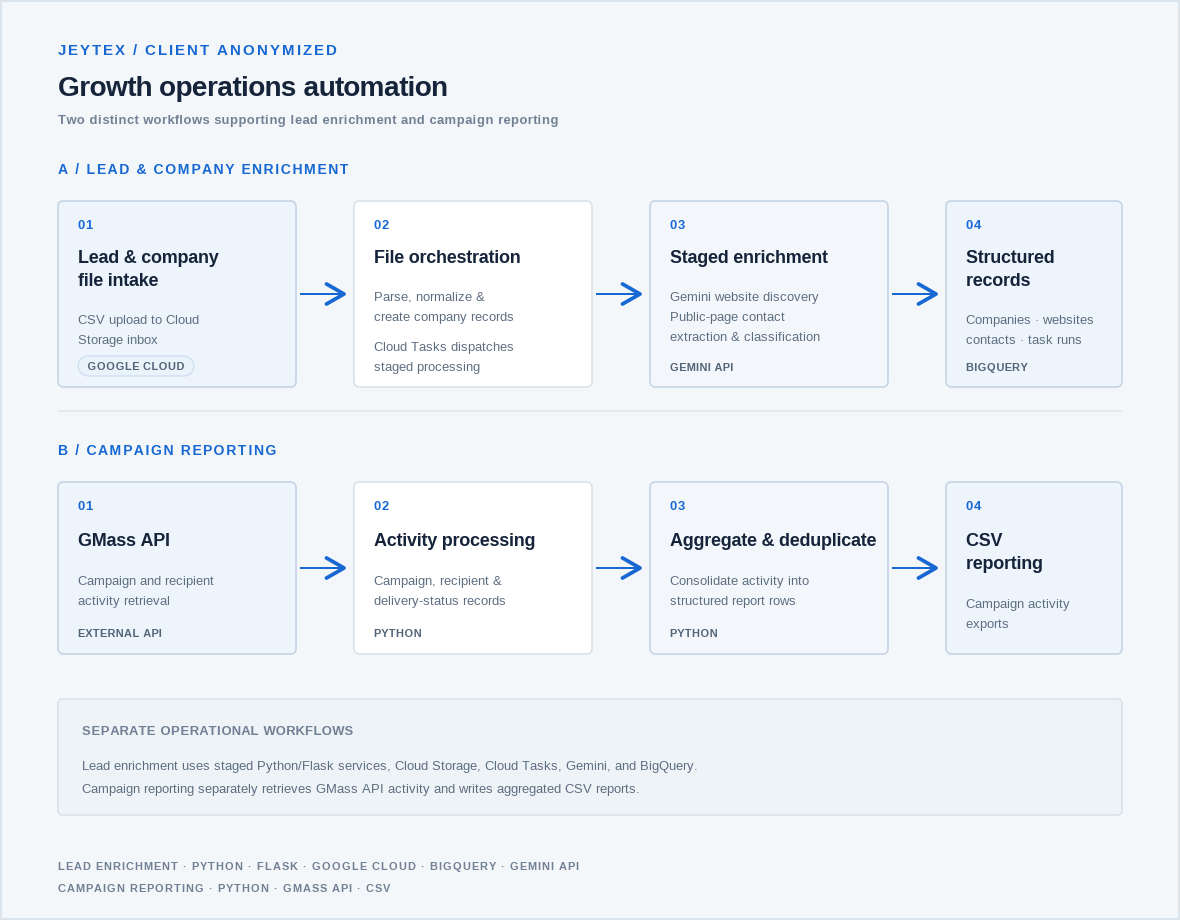
Several workflows, with clear boundaries
Lead enrichment, unsubscribe suppression, and campaign preparation supported the same growth operation but remained separate systems.
Production Proof
Operator workflow and deployed services
Cropped production screenshots retain the system evidence while removing file-history, region, and update-date details.
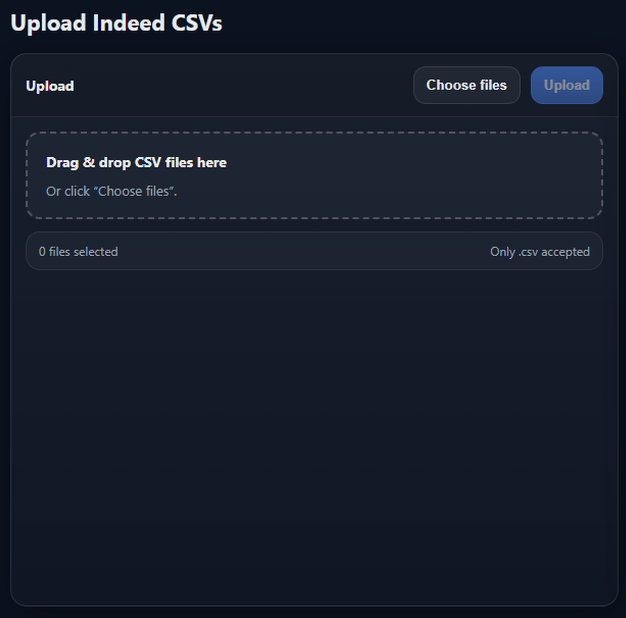
CSV upload interface
The operator interface starts CSV processing; upstream job search and export remained manual.
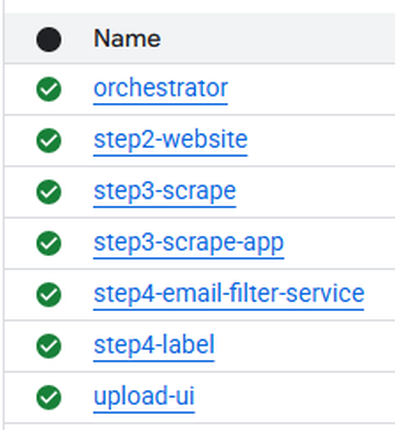
Production Cloud Run services
A production service listing shows dedicated components supporting the staged enrichment workflow.
Campaign Infrastructure
Prepared for multiple sender accounts
Campaign preparation used 11 sender buckets/accounts. The configured theoretical capacity was up to 20,050 contacts per day.
Up to 20,050contacts/day configured capacityConfigured capacity · not observed production throughput
Scope and Completion
Automation advanced in stages
The systems ran in production, but several upstream and downstream parts of the operating model were not completed.
- The initial third-party job search, export, download, and upload remained manual.
- The final enrichment-to-campaign handoff was not completed.
- Continuous ingestion of current blocked and bounce reports was not completed.
- The full reporting/dashboard layer remained incomplete.
- Some campaign timing and daylight-saving edge cases remained.
Jeytex Automation Value Sprint