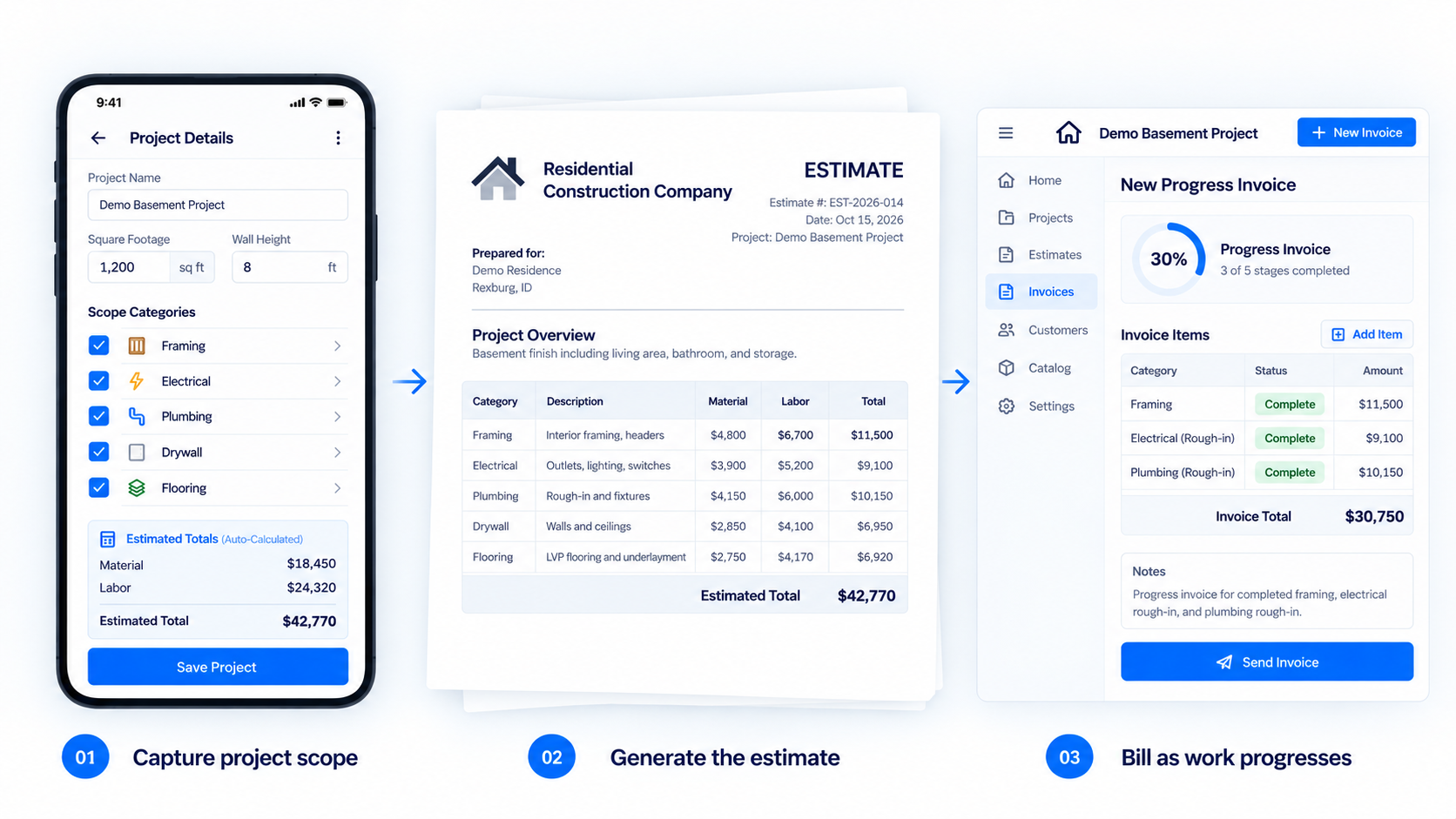
From onsite notes and delayed Excel estimates to same-visit quotes.
Jeytex built a mobile construction estimating and progress-invoicing system that turns project measurements, quantities, and job-specific scope into structured material and labor pricing, customer-ready estimates, and staged invoices.
A field-first workflow built around how the contractor actually estimates and bills work.
60finalized estimates56represented client records37invoices generated11 monthsof estimate records
Production records span December 2025 through October 2026, with estimates recorded in each month; this describes record history, not system uptime.
The Operational Problem
Estimating work continued long after the site visit
Project details were first captured onsite, then rebuilt later into calculations, a quote, and eventually invoice work.
01
Onsite information capture
Project scope and measurements were noted during the customer visit for later follow-up.
02
Excel reconstruction
The estimate and calculations were rebuilt later by hand, with hours of follow-up work reported by the client.
03
Repeated invoice work
Portions of the estimating work had to be done again when preparing invoices.
The prior workflow and time impact are based on client-reported experience.
The Transformation
From delayed reconstruction to a connected estimating workflow
Estimate-specific pricing snapshots were recorded for all 66 current estimates. These are audited system records, not claims of revenue, ROI, or error reduction.
Client-Reported Experience
A faster quote could happen during the visit
The contractor reported that the previous Excel-based process could take hours, with estimates sometimes delivered days later or around the following week. The contractor described at least two early occasions when an estimate was completed and sent while still with a prospective customer, and reported that the immediate quote helped win those jobs.
Qualitative account
The contractor also reported that the system saves hours of manual estimating work. These experiences are not independently measured ROI, exact hours-saved figures, or close-rate statistics.
System Flow
From project scope to staged billing
01Project scope + measurements
02Estimate-specific pricing
03Trade calculation rules
04Material + labor totals
05Branded estimate
06Progress invoicing
Google AppSheet · Google Sheets · Google Docs templates · AppSheet automation
Technical view
AppSheet Structured project inputs
→
Google Sheets Pricing, rules & snapshots
→
Google Docs Estimate & invoice documents
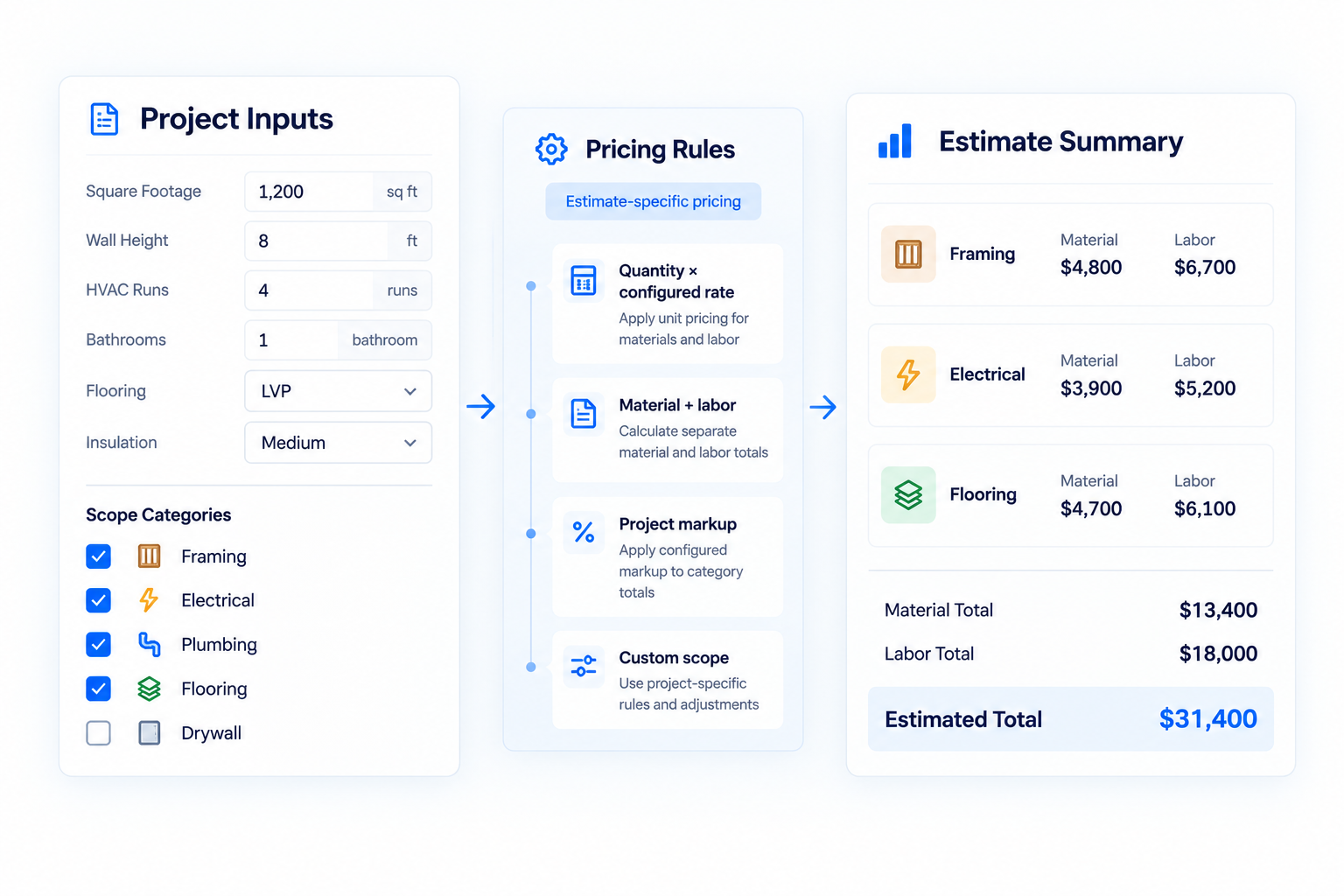
The 177-column estimate model includes roughly 60 derived, virtual, or system fields. Pricing logic uses conditional rules, lookups, aggregation, measurement calculations, and category rollups. The system models material and labor separately and stores estimate-specific pricing snapshots: 6,318 rows across all 66 current estimates.
Pricing Logic
The math happens behind the interface
Measurements and scope selections are translated through configurable pricing rules into separate material and labor calculations.
Illustrative reconstruction of the verified estimating logic using synthetic inputs and pricing.
Progress Invoicing
Estimate scope carried into staged billing
Invoice records show category-level lines tied back to estimate scope.
37invoices
131invoice lines
16estimates reached invoicing
Up to 5invoices associated with one estimate
Observed invoice line percentages include 30%, 70%, and 100%; these examples do not mean every project used the same schedule.
Scope & Completion
Built around the estimating and billing workflow
The system supports structured scope capture, configured pricing, generated documents, and staged invoicing. Illustrative public-proof visuals show the workflow and pricing logic using synthetic inputs.
Estimate and invoice documents are generated from structured project data.
Estimates and invoices are sent directly to customers with a copy to the contractor.
Some system tables and capabilities, including production photos and signatures, were not populated in the audited records.
Jeytex Automation Value Sprint
Your team may not need more software. It may need the right workflow built around how the business actually operates.